The Mud-Field Training
Kevin the Star StrikerThe Mud-Field Training is the Wild Soccer Bunch’s foundational outdoor practice before its decisive match against the Unbeatables. Conducted at 9:00 AM at the park near the lake, it replaces ordinary ball work with a punishing race through mud, holes, stones, and water. Larry’s method converts the players’ physical disadvantage and fear of larger opponents into an athletic resource: the team learns to move like a pebble rather than collide like a boulder. The training’s importance is confirmed during the later match, when twelve days of practice on similarly soft, muddy ground allow the Wild Soccer Bunch to outmaneuver the Unbeatables and overturn a seven-goal deficit.
Setting and Immediate Purpose
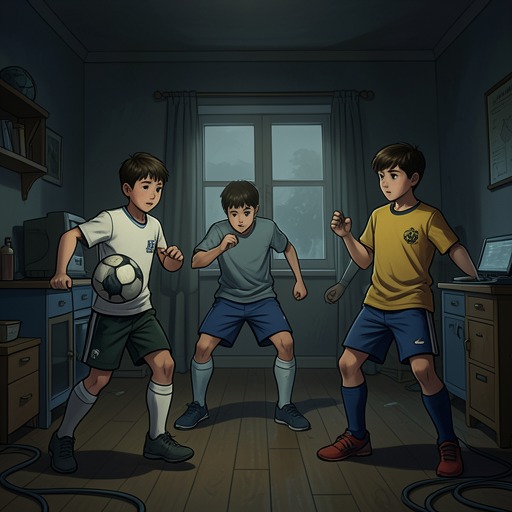
At 9:00 AM, the entire team gathers at the park near the lake, an hour before the scheduled practice. The players are too impatient to wait and begin kicking the ball among themselves, but the opening movement immediately exposes how badly the terrain works against them. Diego slips and lands face first in the muck; Josh and Roger become stuck in mud up to their ankles; Julian and Tyler stumble over stones; and Diego, Alex Alexander, and Kevin plunge into a knee-deep water-filled hole. The field is therefore not a neutral training surface. It is an obstacle course that makes ordinary soccer movement awkward, embarrassing, and dangerous.
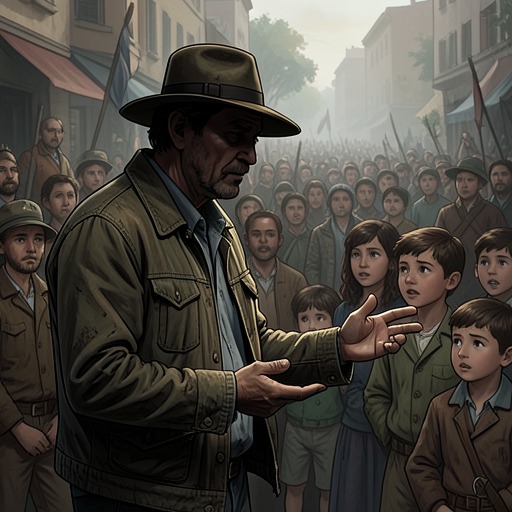
Larry watches from a tree trunk and, after the players have struggled through the opening scramble, sends Kevin’s ball to the far end of the field. He argues that the water is too cold for swimming and that the team must first learn how to run. The decision to take away the ball is deliberate rather than accidental. Larry expects Mickey the Bulldozer and the Unbeatables to play unfairly, so he makes the players rehearse the conditions of a match in which opponents will foul, block, and charge them. Stones and holes become the legs of hostile players; the terrain becomes a rehearsal for contact and evasion.
Larry’s Fear-and-Movement Method
Larry assigns the players to race in pairs. They must dodge the stones, jump over the holes, and dance between them instead of trying to overpower the obstacles. When Danny objects that the mud is as slippery as an ice rink, Larry embraces the comparison: the slipperiness is precisely what the players need to master. He identifies the mud with fear and with the unstable knees they will feel when players such as Mow-down, Juggernaut Jim, or Kong run toward them. Fear is not treated as a private weakness to be denied; it is given a physical surface and made into something the body can practice crossing.
Julian Fort Knox initially responds with defiance, insisting that he can simply take the ball away. Larry counters this confidence with a small pebble and a large boulder. The pebble represents a Wild Soccer Bunch player, while the boulder represents the Unbeatables. When Larry throws the pebble directly at the boulder, it rebounds helplessly. He then demonstrates the alternative: thrown flat, the pebble lands in a puddle, bounces over the boulder, and continues over three more large stones. Larry’s lesson is that size is not the only measure of strength. Speed, lightness, nimbleness, and the ability to change direction allow the smaller player to escape the larger one.
The drill also embodies Larry’s demand for mutual trust. Before the training, he tells the players that he must trust them completely and that they must trust him completely if they are to beat the Unbeatables. The muddy exercise gives that principle a collective form. Each player repeatedly fails in public, yet the group continues rather than separating into winners and embarrassments. The practice thus joins technical instruction to emotional discipline: the team learns not merely to run, but to remain active after slipping, falling, and being made to feel small.
Repetition, Play, and Transformation
Once the players understand the pebble’s advantage, they race again and again. They slip, fall, plunge into puddles, and scrape their knees and elbows, but nobody gives up. The repetition changes the meaning of the ground. What first appeared as an enemy landscape becomes a field whose irregularities the players can read and exploit. By the end, they perform the course blindfolded. When Larry turns on his boom box, they move to the rhythm of the music, and the muddy field seems smoother than a golf course as they dance across it.
This shift is both physical and social. The players begin in confusion, with individuals trapped, falling, or unable to advance, but finish as a group capable of converting shared failure into laughter. Larry rewards them with lemonade from his stand. They are exhausted, yet they cannot stop laughing, and their fantasies turn the power relationship with the Unbeatables upside down: they imagine Mickey, Humungous Henry, and Kong trapped outside Larry’s stand, pleading for something to drink. The fantasy does not win the match, but it gives the players a new emotional position before the match begins. The opponents who seemed monstrous can now be imagined as vulnerable.
Larry also promises that the team will finally play with a ball the following day. The delay makes the absence of the ball part of the lesson. The players must first learn the movement that will let them survive the game; only afterward will the familiar object return. By the end of the first day, the Wild Soccer Bunch feels fabulous and no longer doubts that it can beat Mickey and the Unbeatables. Confidence arises not from reassurance alone, but from repeated bodily proof that the team can function under hostile conditions.
Tactical Payoff in the Match
The training becomes visible twelve days later, when rain makes the match ground soft and muddy. At first the Unbeatables hold a commanding seven-to-one lead, but the surface that troubles them is familiar to the Wild Soccer Bunch. The team dances through the opposing ranks while the Unbeatables slide around like ducks on an ice rink. Kevin scores his third goal for a hat-trick, Danny scores his second, Joey drives the ball into the corner to make the score seven to seven, and Tyler controls midfield before scoring from halfway down the field with the help of a gust of wind.
The tactical pattern learned in the mud is not limited to running. Tyler draws Mow-down, Juggernaut Jim, and Humungous toward him, then passes to Danny; Danny sends the ball toward the penalty spot, where Kevin takes it from the air. When Rick the Grim Reaper slides into Kevin, Kevin’s heel pass reaches Alex Alexander, whose shot beats Octopus and carries him into the goal with the ball. Julian, once embarrassed by Larry’s lesson about the pebble, later refuses to avoid Kong. He presses the ball against Kong’s foot, stays in front of him, and wins possession. The smaller, quicker player has learned to confront size through positioning and persistence rather than through a direct collision.
The same discipline governs the final crisis. After the score reaches nine to nine, Kevin’s desire to score the tenth goal causes him to keep the ball instead of passing, and Larry removes him from the field. Roger hesitates, misses a chance, and appears to threaten the team’s victory, while Kyle makes a diving save in the lower-left corner and then redirects Kong’s follow-up shot around the post. The match remains a collective test rather than a showcase for one player. When Roger finally strikes the winning goal, the Wild Soccer Bunch wins, carries him across the field, and recognizes him as a hero.
Significance
The Mud-Field Training changes the team’s definition of strength. The Unbeatables claim the soccer field through size, intimidation, and exclusion, while the Wild Soccer Bunch answers by creating a different kind of power from movement, adaptation, and solidarity. Larry’s pebble-and-boulder demonstration supplies the image that organizes the training: the boulder appears formidable because it is large, but the pebble survives by being quick and able to dance.
The action also gives material form to the book’s larger insistence that fear can become strength. The players do not become fearless; they learn to move while afraid, to trust one another while falling, and to turn an apparently ruined field into their advantage. The later comeback—from seven to one down to a nine-nine tie and then victory—makes the training’s promise concrete. The Wild Soccer Bunch wins not because the mud disappears, but because the team has learned how to play inside it.